
Pollution License Registration in India: Complete Guide for Businesses
Pollution License Registration is an important environmental compliance requirement for businesses involved in manufacturing, processing, production, and other activities that may impact the environment. Before starting operations, many businesses must obtain approval from the State Pollution Control Board to ensure they comply with environmental regulations.
If you are planning to start a factory, industrial unit, warehouse, or manufacturing business, understanding the Pollution License Registration process can help you avoid legal issues and operate your business smoothly.
What is pollution license registration?
Pollution License Registration is the approval granted by the State Pollution Control Board (SPCB) or Pollution Control Committee (PCC). The license confirms that a business follows environmental standards related to air pollution, water pollution, waste management, and environmental protection.
Generally, businesses obtain environmental consent before establishing and operating industrial activities.
Types of Pollution License Registration
Consent to Establish (CTE)
A consent to establish is required before setting up a factory, industrial unit, or project. It allows businesses to begin construction and installation activities after environmental review.
Consent to Operate (CTO)
A consent to operate is required before commercial production or operations begin. It confirms that the business has implemented the necessary pollution control measures.
Both approvals form an important part of the pollution license process.
Who Needs Pollution License Registration?
A pollution license is commonly required for:
- Manufacturing units
- Factories
- Chemical industries
- Food processing units
- Pharmaceutical companies
- Textile industries
- Engineering units
- Packaging industries
- Recycling businesses
- Warehouses handling regulated materials
However, the exact requirements depend on the category and nature of the business.
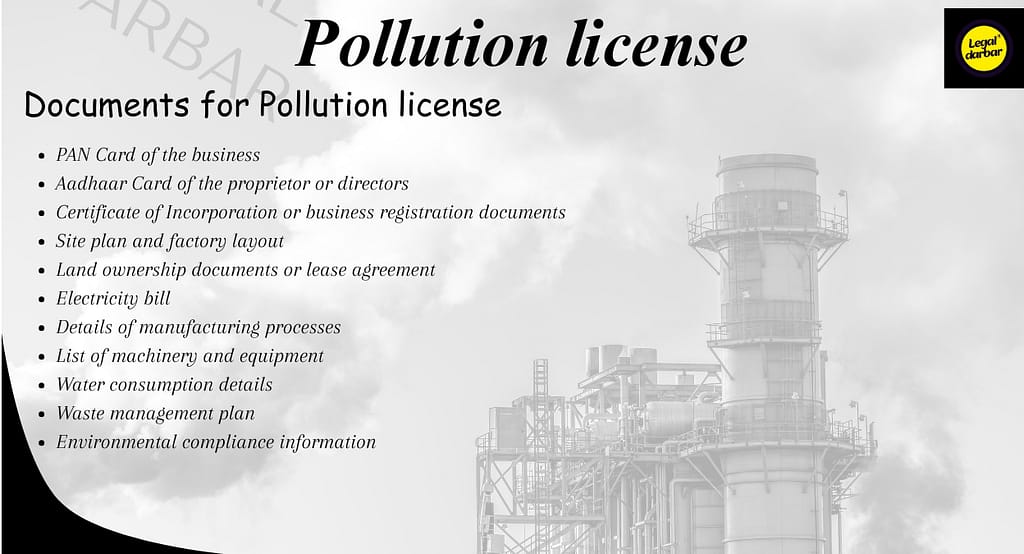
Documents Required for Pollution License
To apply for a pollution license, businesses generally need the following:
- PAN Card of the business
- Aadhaar Card of the proprietor or directors
- Certificate of Incorporation or business registration documents
- Site plan and factory layout
- Land ownership documents or lease agreement
- Electricity bill
- Details of manufacturing processes
- List of machinery and equipment
- Water consumption details
- Waste management plan
- Environmental compliance information
In some cases, authorities may request additional documents based on the industry type.
Pollution License Registration Process
Application Preparation
The first step involves collecting all required documents and preparing details about the manufacturing process and environmental impact.
Application Submission
The applicant submits the pollution license application through the relevant state pollution control board portal.
Technical Review
The authorities review the application and evaluate compliance with environmental requirements.
Site Inspection
In certain cases, officials may inspect the premises to verify the information provided.
Approval and License Issuance
Once the business satisfies all environmental requirements, the authority grants the pollution license registration approval.
Benefits of Pollution License Registration
Legal Compliance
Pollution license helps businesses comply with environmental laws and regulations.
Smooth Business Operations
Businesses can operate without interruption and avoid regulatory complications.
Environmental Responsibility
The registration process encourages responsible waste management and pollution control practices.
Better Business Reputation
Customers, investors, and government agencies often prefer environmentally compliant businesses.
Reduced Legal Risks
Businesses can avoid penalties, notices, and legal action related to environmental violations.
Consequences of Operating Without Pollution License Registration
Businesses that fail to obtain a pollution license may face the following:
- Financial penalties
- Closure notices
- Legal proceedings
- Suspension of industrial operations
- Difficulty obtaining other government approvals
Therefore, obtaining a pollution license before commencing operations is highly recommended.
Related Business Compliance Services
Along with a pollution license, businesses may also require:
- Company Registration
- GST Registration
- Factory License Registration
- Fire License Registration
- Trade License Registration
- Labour Law Compliance
These services can be internally linked on the Legal Darbar website to improve SEO and user navigation.
Why Choose Legal Darbar for Pollution License?
Legal Darbar provides professional assistance for pollution licenses across India. Our team helps businesses with document preparation, application filing, compliance support, and coordination with relevant authorities. As a result, clients can complete the registration process efficiently and focus on growing their business.