
What is Income Tax Return (ITR) Filing?
Taxpayers use an Income Tax Return (ITR) form to report income and tax payments to the Income Tax Department. There are 7 ITR forms (ITR 1 to ITR 7), each designed for different types of taxpayers and income sources. Filing must be done accurately and by the deadline to comply with tax laws.
Eligibility for Income Tax Filing
You need to file your income tax return if your gross total income exceeds the basic exemption limits:
- Individuals under 60 years: Rs 2.5 lakh
- Individuals between 60 and 80 years: Rs 3.0 lakh
- Individuals over 80 years: Rs 5.0 lakh
Other cases requiring filing even if income is below limits:
- Deposited Rs 1 crore or more in current accounts
- Deposited Rs 50 lakh or more in savings accounts
- Spent over Rs 2 lakh on foreign travel
- Electricity expenses over Rs 1 lakh in a financial year
- TDS or TCS exceeding Rs 25,000 (Rs 50,000 for senior citizens)
Income Tax Return Forms in India
- ITR-1 (SAHAJ): For individuals with salary/pension income below Rs 50 lakhs and one house property.
- ITR-2: For NRIs, company directors, shareholders, capital gains income, foreign income, or multiple house properties.
- ITR-3: For professionals and proprietorship businesses.
- ITR-4: For presumptive taxation scheme enrollees with business income below Rs 2 crores or professional income below Rs 50 lakhs.
- ITR-5: For partnership firms, LLPs, associations, and bodies of individuals.
- ITR-6: For registered companies.
- ITR-7: For special entities like trusts, political parties, research institutions, universities.
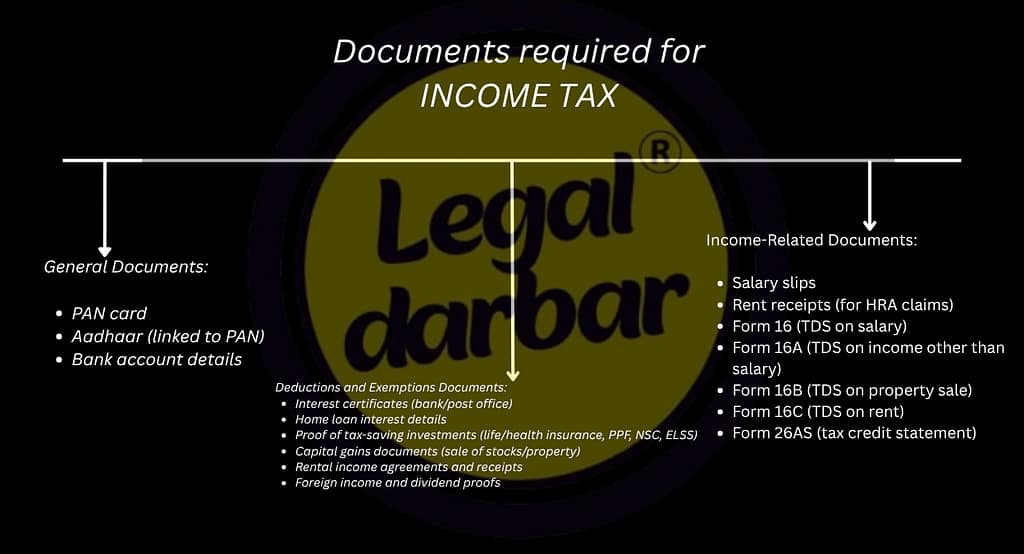
Documents Required for ITR e-Filing
General Documents:
- PAN card
- Aadhaar (linked to PAN)
- Bank account details
Income-Related Documents:
- Salary slips
- Rent receipts (for HRA claims)
- Form 16 (TDS on salary)
- Form 16A (TDS on income other than salary)
- Form 16B (TDS on property sale)
- Form 16C (TDS on rent)
- Form 26AS (tax credit statement)
Deductions and Exemptions Documents:
- Interest certificates (bank/post office)
- Home loan interest details
- Proof of tax-saving investments (life/health insurance, PPF, NSC, ELSS)
- Capital gains documents (sale of stocks/property)
- Rental income agreements and receipts
- Foreign income and dividend proofs
Need Assistance?
For expert guidance through the ITR filing process, you can reach out to Legal Darbar. They provide dedicated support and simplify the filing journey. You can contact them by calling or visiting their office via the provided link.