
Manufacturing businesses in India must comply with several legal requirements before commencing operations. Among these, Factory License Registration is one of the most important approvals required under Indian labour laws. Whether you are starting a small manufacturing unit or establishing a large-scale production facility, obtaining a factory license helps ensure that your business operates legally while maintaining safety, health, and welfare standards for workers.
A valid factory license not only protects business owners from legal penalties but also builds trust with customers, suppliers, and government authorities. Moreover, many financial institutions and government schemes require manufacturers to possess valid factory registration before granting benefits.
In this comprehensive guide, you’ll learn everything about Factory License Registration, including eligibility, required documents, registration procedure, fees, renewal process, penalties, and practical compliance tips.
What is Factory License Registration?
Factory License Registration is a legal authorization issued by the Labour Department of the respective State Government under the Factories Act, 1948 (or corresponding state rules). It permits a manufacturing unit to operate after meeting prescribed safety, health, and welfare standards.
The license confirms that the factory has complied with government regulations related to:
- Worker safety
- Fire protection
- Ventilation
- Machinery installation
- Building approval
- Environmental compliance
- Employee welfare measures
Without a valid factory license, operating a manufacturing unit can result in penalties, legal action, or even closure of the business.
Why is Factory License Registration Important?
Obtaining a factory license is more than just a legal formality. It safeguards both employers and employees.
Some key reasons include:
- Ensures compliance with labour laws.
- Promotes workplace safety.
- Reduces legal risks.
- Helps obtain government approvals.
- Builds business credibility.
- Facilitates bank loans and investments.
- Supports smooth inspections by authorities.
Additionally, a licensed factory demonstrates professionalism and commitment to regulatory compliance.
Who Needs Factory License Registration?
A factory license is generally required for manufacturing units that satisfy the criteria specified under the Factories Act.
Typically, registration becomes mandatory if:
Using Electricity
- 10 or more workers are employed.
- Manufacturing activities are carried out with power.
Without Electricity
- 20 or more workers are employed.
- Manufacturing activities are carried out without power.
Examples include:
- Textile factories
- Food processing plants
- Plastic manufacturing units
- Chemical factories
- Pharmaceutical manufacturers
- Automobile component manufacturers
- Steel fabrication workshops
- Packaging industries
However, specific requirements may vary slightly from state to state.
Eligibility Criteria for Factory License Registration
To obtain Factory License Registration, applicants generally need to satisfy the following conditions:
1. Manufacturing Activity
The business must be engaged in manufacturing, processing, assembling, repairing, packing, or similar industrial activities.
2. Worker Strength
The factory should meet the minimum worker requirement prescribed under applicable labour laws.
3. Approved Factory Building
The premises should have:
- Approved building plans
- Proper ventilation
- Emergency exits
- Fire safety systems
- Adequate sanitation facilities
4. Occupancy Certificate
Many states require an approved occupancy certificate before issuing the factory license.
5. Compliance with Safety Standards
The factory must comply with occupational health and industrial safety regulations.
Laws Governing Factory License Registration
Several legal provisions regulate factories in India.
The major laws include:
| Law | Purpose |
|---|---|
| Factories Act, 1948 | Factory registration and worker welfare |
| Occupational Safety, Health and Working Conditions Code | Workplace safety and health |
| State Factory Rules | State-specific licensing procedures |
| Building Bye-Laws | Factory building approval |
| Fire Safety Regulations | Fire prevention and emergency measures |
| Environmental Laws | Pollution and waste management compliance |
Manufacturers should also comply with pollution control regulations wherever applicable.
Benefits of Factory License Registration
Obtaining a factory license offers numerous operational and legal advantages.
1. Legal Compliance
The license ensures that your manufacturing business operates within the legal framework established by the government.
2. Improved Worker Safety
Registered factories must follow prescribed safety standards, reducing workplace accidents.
3. Better Business Reputation
Customers, suppliers, and financial institutions often prefer working with legally compliant manufacturers.
4. Easier Government Approvals
Many industrial incentives and subsidies require a valid factory registration certificate.
5. Smooth Labour Inspections
A properly registered factory can handle inspections more efficiently because necessary approvals and records are already maintained.
6. Access to Business Loans
Banks frequently request legal licenses before approving business financing.
7. Reduced Legal Risks
Timely registration helps avoid penalties, prosecution, and business interruptions.
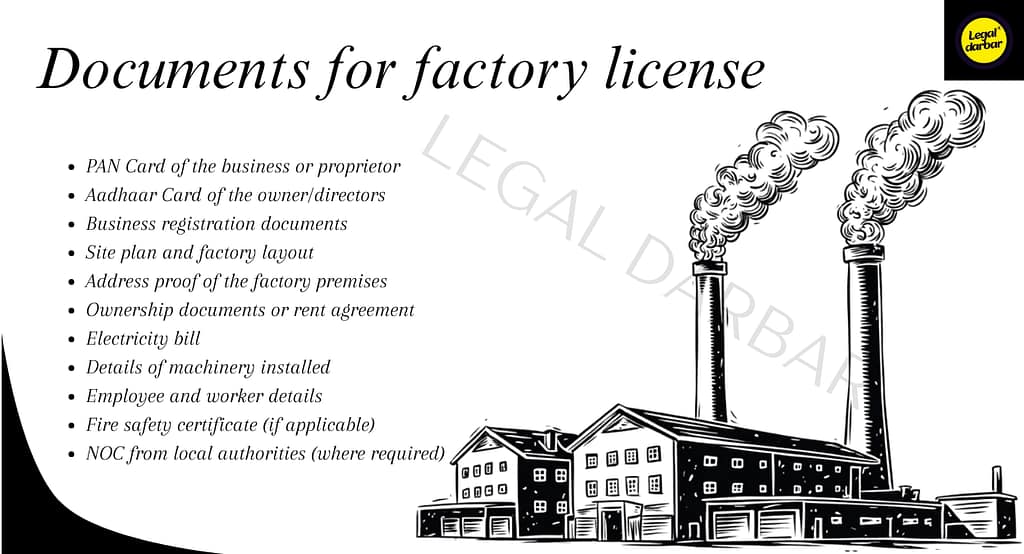
Factory License Registration Documents
Preparing accurate documentation is one of the most important steps in the registration process.
Common Factory License Registration documents include:
| Document | Purpose |
|---|---|
| Identity proof of occupier | Applicant verification |
| PAN Card | Tax identification |
| Aadhaar Card | Identity proof |
| Address proof | Business verification |
| Certificate of Incorporation (if applicable) | Company registration |
| Partnership Deed (if applicable) | Partnership verification |
| Factory building plan | Structural approval |
| Site layout plan | Factory layout |
| Ownership proof or lease deed | Property verification |
| Electricity connection details | Utility verification |
| Machinery details | Manufacturing information |
| Fire Safety NOC | Fire compliance |
| Pollution Control NOC (if applicable) | Environmental compliance |
| Board Resolution | Company authorization |
Step-by-Step Factory License Registration Process
The registration process may differ slightly across states, but the general steps remain similar.
Step 1: Prepare Required Documents
Collect all business, property, safety, and identity documents before starting the application.
Step 2: Factory Building Approval
Obtain approval of the factory building plan from the competent authority.
Step 3: Register on the State Labour Department Portal
Create an account on your state’s labour department portal (where online registration is available).
Step 4: Fill Out the Application Form
Provide accurate details regarding:
- Business information
- Factory address
- Manufacturing activities
- Number of workers
- Machinery installed
- Occupier details
- Manager details
Step 5: Upload Documents
Upload scanned copies of all required supporting documents in the prescribed format.
Step 6: Payment of Government Fees
After filling out the application and uploading the required Factory License Registration documents, the next step is to pay the prescribed government fee.
The registration fee varies depending on several factors, including:
- Factory location
- State government rules
- Number of workers
- Installed horsepower (HP) of machinery
- Nature of manufacturing activity
- License validity period
Most state labour department portals allow online payment through:
- Net Banking
- UPI
- Credit/Debit Cards
- NEFT/RTGS (in some states)
Tip: Keep a copy of the payment receipt for future reference and inspections.
Step 7: Factory Inspection by the Labour Department
Once the application is submitted, the concerned Factory Inspector or Labour Department official reviews the documents. In many cases, a physical inspection of the factory premises is conducted.
During the inspection, the officer typically checks:
Building Safety
- Approved factory layout
- Structural stability
- Emergency exits
- Staircases
- Ventilation
Machinery Safety
The inspector verifies that machinery is installed safely and includes proper guards and safety devices to minimize workplace accidents.
Worker Welfare Facilities
Authorities may inspect facilities such as:
- Drinking water
- Toilets and sanitation
- First aid arrangements
- Washing facilities
- Restrooms (where applicable)
Fire Safety Measures
The inspector checks whether the factory has:
- Fire extinguishers
- Fire alarms
- Emergency exits
- Evacuation plans
- Fire NOC (if required)
Environmental Compliance
Depending on the type of industry, authorities may also verify:
- Waste disposal systems
- Air pollution control
- Water treatment facilities
- Hazardous waste management
Step 8: Verification of Documents
After the inspection, officials verify all submitted Factory License Registration documents.
If any document is missing or incorrect, the applicant may receive a notice requesting clarification or additional information.
Common reasons for delays include:
- Incorrect building plans
- Missing ownership proof
- Invalid Fire NOC
- Mismatch in worker details
- Incomplete application form
Providing accurate information from the beginning helps speed up the approval process.
Step 9: Issuance of Factory License
Once the inspection and document verification are successfully completed, the Labour Department issues the Factory License Registration Certificate.
The certificate generally contains:
- Factory License Number
- Name of Factory
- Occupier’s Name
- Factory Address
- Nature of Manufacturing Activity
- Maximum Number of Workers Allowed
- Installed Power Capacity
- Validity Period
Keep both a physical and a digital copy of the license, as it may be required during inspections, audits, or while applying for other business registrations.
Factory License Registration Fees
The government does not have a single nationwide fee structure. Instead, each state determines its own licensing fees.
The fee generally depends on:
| Factor | Impact on Fee |
|---|---|
| Number of Workers | Higher workforce may increase fees |
| Installed Machinery Power | More HP often means higher fees |
| Factory Area | Larger premises may attract higher charges |
| Nature of Manufacturing | Hazardous industries may have different fee structures |
| License Validity | Multi-year licenses may cost more initially |
Before applying, check the fee schedule issued by your State Labour Department.
Validity of Factory License
The validity period of a Factory License differs from state to state.
Generally, licenses are issued for:
- 1 Year
- 3 Years
- 5 Years
- 10 Years (in some states)
Businesses should monitor the expiry date and apply for renewal well in advance to avoid interruptions.
Factory License Renewal Process
Renewing a factory license is just as important as obtaining one.
A timely renewal helps your business remain compliant and avoids penalties.
Renewal Process
- Log in to the State Labour Department portal.
- Select the Factory License Renewal option.
- Update factory details if required.
- Upload any revised documents.
- Pay the renewal fee.
- Submit the application.
- Await approval or inspection, if applicable.
Best Practice: Apply for renewal at least 30–60 days before the license expires.
Penalties for Operating Without a Factory License
Running a factory without a valid license can have serious legal and financial consequences.
Possible penalties include:
- Monetary fines
- Suspension of manufacturing activities
- Closure of the factory
- Legal proceedings against the occupier
- Cancellation of government approvals
- Difficulty obtaining bank loans or government tenders
Compliance not only protects your business but also strengthens your reputation.
Common Mistakes to Avoid During Factory License Registration
Many applications are delayed due to avoidable errors.
Here are some common mistakes:
1. Submitting Incomplete Documents
Missing ownership proof, identity documents, or building plans can delay approval.
2. Incorrect Factory Layout
An unapproved or inaccurate site plan often leads to objections from the authorities.
3. Ignoring Fire Safety Requirements
Factories without proper fire safety measures may fail the inspection.
4. Providing Incorrect Worker Information
Always mention the correct number of workers and manufacturing details.
5. Delaying Renewal
An expired factory license may result in penalties and operational disruptions.
6. Non-Compliance with Environmental Regulations
Industries generating waste or emissions should obtain the necessary environmental approvals.
Best Practices for Maintaining Factory Compliance
Obtaining a factory license is only the beginning. Manufacturers should also focus on ongoing compliance.
Some practical tips include:
- Conduct regular safety audits.
- Train employees on workplace safety.
- Maintain updated employee records.
- Service machinery periodically.
- Renew licenses before expiry.
- Keep emergency exits unobstructed.
- Maintain fire safety equipment.
- Display mandatory notices inside the factory.
- Preserve inspection reports and compliance records.
Following these practices can reduce legal risks and improve operational efficiency.
Frequently Asked Questions (FAQs)
1. What is Factory License Registration?
Factory License Registration is a legal approval issued by the State Labour Department that allows eligible manufacturing units to operate under applicable factory laws while ensuring worker safety and compliance.
2. Who needs Factory License Registration?
Generally, manufacturing units employing 10 or more workers with power or 20 or more workers without power require a factory license. However, specific rules may vary by state.
3. What are the important Factory License Registration documents?
Some commonly required documents include:
- PAN Card
- Aadhaar Card
- Address Proof
- Factory Building Plan
- Site Layout
- Fire NOC
- Ownership Proof
- Machinery Details
- Certificate of Incorporation (if applicable)
- Pollution Control Approval (where applicable)
4. How long does Factory License Registration take?
The processing time varies by state and depends on document verification and inspection. In many cases, it may take 15 to 45 working days, provided all documents are complete.
5. Can Factory License Registration be completed online?
Yes. Many State Labour Departments provide online portals where applicants can submit forms, upload documents, pay fees, and track application status.
6. Is Factory License Registration mandatory for every manufacturing business?
No. The requirement depends on factors such as the number of workers employed and whether manufacturing is carried out with or without the aid of power, as specified under applicable laws.
Conclusion
Factory License Registration is a crucial legal requirement for manufacturers operating in India. It not only ensures compliance with labour and safety regulations but also enhances the credibility and long-term sustainability of a business.
By understanding the eligibility criteria, preparing the required Factory License Registration documents, following the registration process carefully, and maintaining timely renewals, manufacturers can avoid legal complications and create a safer workplace for employees.
If you are starting a new factory or expanding an existing manufacturing unit, obtaining a valid Factory License Registration should be one of your top priorities. A compliant business is better positioned for growth, funding opportunities, and lasting success.