
Introduction
If you are planning to start a food-related business in India, obtaining a food license registration is one of the most important legal requirements. Whether you run a restaurant, cloud kitchen, bakery, food manufacturing unit, catering service, or online food business, FSSAI registration helps ensure compliance with food safety regulations.
Moreover, an FSSAI license builds trust among customers and enhances the credibility of your business. It demonstrates that your food products meet the safety and quality standards prescribed by the government.
In this guide, we explain everything about FSSAI Food License Registration, including its benefits, eligibility, documents required, registration process, and compliance requirements.
What is an FSSAI food license?
FSSAI stands for the Food Safety and Standards Authority of India. It is the regulatory body responsible for ensuring food safety and maintaining food quality standards across the country.
An FSSAI License or Registration is a mandatory authorization required for businesses involved in the manufacturing, processing, storage, distribution, transportation, or sale of food products.
Furthermore, every registered food business receives a unique FSSAI registration or license number that must be displayed on food packages and business premises.
Why is FSSAI Registration Important?
FSSAI registration is not only a legal requirement but also a mark of quality assurance.
Additionally, it helps businesses establish customer confidence and avoid penalties related to food safety violations. As a result, businesses can operate smoothly and expand their market presence.
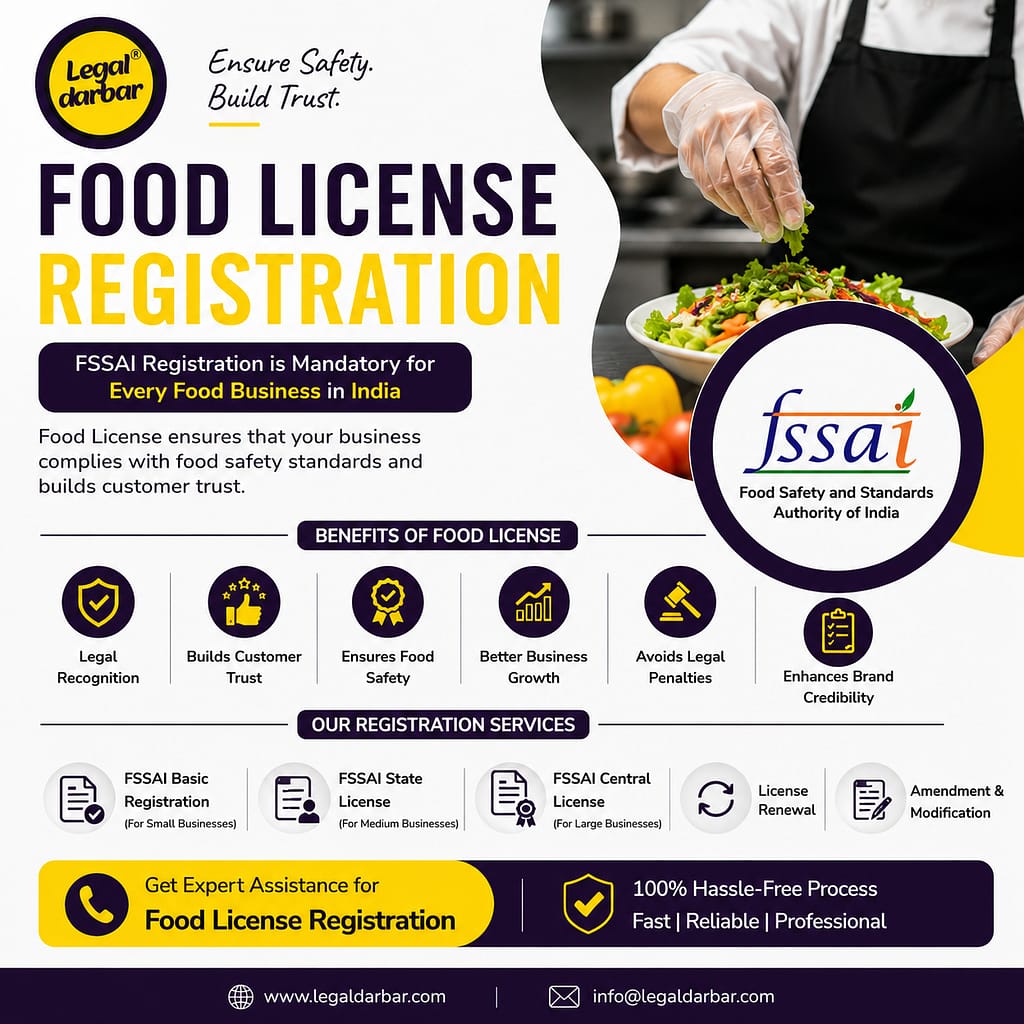
Benefits of FSSAI Food License Registration
1. Legal Compliance
An FSSAI license ensures that your food business operates according to government regulations.
2. Customer Trust
Consumers are more likely to purchase food products from businesses that display a valid FSSAI license number.
3. Improved Brand Reputation
Moreover, an FSSAI-certified business enjoys greater credibility in the marketplace.
4. Business Expansion Opportunities
Many online marketplaces, food delivery platforms, and retail chains require a valid FSSAI license before onboarding food businesses.
5. Better Food Safety Standards
Compliance with FSSAI guidelines helps maintain hygiene and food quality standards.
6. Easy Access to Funding
Investors and financial institutions often prefer businesses that comply with all regulatory requirements.
Types of FSSAI Registration and Licenses
Basic FSSAI Registration
This registration is suitable for small food businesses with limited turnover.
Examples include:
- Home-based food businesses
- Small retailers
- Small food vendors
- Local food sellers
State FSSAI License
This license is generally required for medium-sized food businesses operating within a single state.
Examples include:
- Restaurants
- Mid-sized manufacturers
- Storage units
- Transporters
Central FSSAI License
This license is required for large businesses operating across multiple states or involved in import-export activities.
Examples include:
- Large manufacturers
- Importers and exporters
- Large food chains
- E-commerce food operators
Who Needs an FSSAI License?
The following businesses generally require FSSAI registration or licensing:
- Restaurants
- Cafes
- Hotels
- Bakeries
- Cloud Kitchens
- Food Manufacturers
- Food Processors
- Caterers
- Food Delivery Businesses
- Online Food Sellers
- Dairy Businesses
- Wholesalers and Distributors
- Importers and Exporters of Food Products
Documents Required for FSSAI Registration
Identity and Address Proof
- PAN Card
- Aadhaar Card
- Passport-sized Photograph
Business Documents
- Business Registration Certificate
- GST Registration (if applicable)
- Partnership Deed or Incorporation Certificate
Premises Documents
- Electricity Bill
- Rent Agreement
- Property Documents
- No Objection Certificate (NOC)
Additional Documents
Depending on the type of food business, additional documents may be required by the authorities.
Step-by-Step FSSAI Registration Process
Step 1: Determine the Applicable License
First, identify whether your business requires basic registration, a state license, or a Central License.
Step 2: Prepare Documents
Next, collect all required identity, business, and premises documents.
Step 3: Submit Application
The application is submitted through the official FSSAI registration portal.
Step 4: Verification
The authorities review the application and verify the submitted information.
Step 5: Inspection (If Required)
In certain cases, an inspection of the business premises may be conducted.
Step 6: License Approval
Once the application is approved, the food license registration or license is issued.
FSSAI License Validity
FSSAI licenses are generally issued for a period ranging from 1 to 5 years, depending on the applicant’s choice.
However, businesses must renew their licenses before the expiry date to avoid penalties and interruptions in operations.
Penalties for Operating Without an FSSAI License
Running a food business without the required food license registration can lead to:
- Monetary penalties
- Business closure notices
- Legal action
- Suspension of operations
- Damage to business reputation
Therefore, obtaining the appropriate license is essential before starting operations.
Common Mistakes to Avoid
Businesses should avoid the following mistakes:
- Applying for the wrong license category
- Submitting incomplete documents
- Delaying license renewal
- Providing incorrect business information
- Ignoring food safety guidelines
Consequently, professional assistance can help ensure a smooth and error-free registration process.
Why Choose Legal Darbar for FSSAI Registration?
Legal Darbar provides complete assistance for FSSAI food license registration across India.
Our Services Include
- Basic FSSAI Registration
- State FSSAI License
- Central FSSAI License
- FSSAI Renewal
- License Modification
- Food Business Compliance Support
- Import Export Food License Assistance
Moreover, our experts ensure accurate documentation, timely filing, and end-to-end support throughout the registration process.
One Response