
Introduction
If you want to start an import or export business in India, obtaining an Import Export Code (IEC) registration is one of the first legal requirements you must fulfill. Without an IEC, businesses cannot legally import goods into India or export products and services to international markets.
Moreover, Import Export Code (IEC) registration is a simple process that opens the door to global trade opportunities. Whether you are a manufacturer, trader, startup, e-commerce seller, or service provider, an IEC can help your business expand beyond domestic markets.
In this guide, we explain everything about Import Export Code registration, including its benefits, eligibility, required documents, registration process, and compliance requirements.
What is an Import Export Code (IEC)?
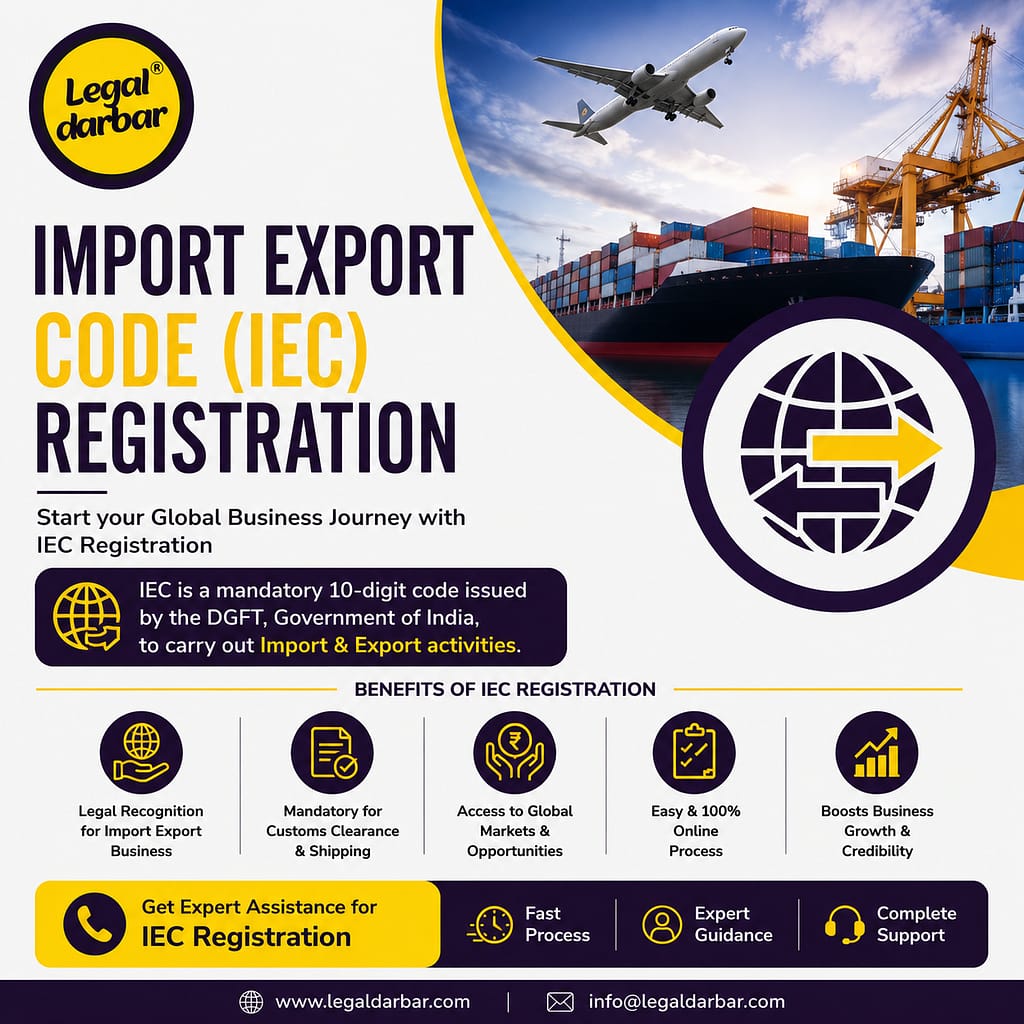
An Import Export Code (IEC) is a 10-digit identification number issued by the Directorate General of Foreign Trade (DGFT). It is mandatory for businesses and individuals involved in importing or exporting goods and services from India.
Furthermore, the IEC serves as a unique identification number for all international trade transactions. Once issued, the code remains valid for the lifetime of the business unless it is surrendered or canceled.
Why is IEC Registration Important?
IEC registration is essential for businesses that wish to engage in international trade. Without it, import and export activities cannot be conducted legally.
Additionally, banks, customs authorities, and government agencies often require the IEC for processing international transactions and shipments.
Benefits of IEC Registration
1. Access to Global Markets
An IEC allows businesses to expand their operations internationally. As a result, companies can reach new customers and increase revenue.
2. Easy Import and Export Operations
With an IEC, businesses can clear shipments through customs without unnecessary delays.
3. Lifetime Validity
Unlike many registrations, an IEC does not require frequent renewals. Therefore, businesses can enjoy long-term benefits without recurring registration costs.
4. Government Incentives
Exporters may become eligible for various government schemes, incentives, and benefits offered under foreign trade policies.
5. Increased Business Credibility
International buyers and suppliers often prefer dealing with businesses that possess a valid IEC registration.
6. Simple Registration Process
The IEC application process is completely online and can usually be completed within a short period.
Who Needs IEC Registration?
The following entities generally require an IEC:
- Proprietorship Firms
- Partnership Firms
- LLPs
- Private Limited Companies
- One Person Companies (OPCs)
- Trusts and Societies
- Exporters of Goods
- Importers of Goods
- Service Exporters
However, certain government departments and specified entities may be exempt from obtaining an IEC.
Documents Required for IEC Registration
To apply for an Import Export Code, the following documents are generally required:
For Proprietorship Firms
- PAN Card of Proprietor
- Aadhaar Card
- Address Proof
- Bank Account Details
- Cancelled Cheque
For Companies and LLPs
- PAN Card of Entity
- Certificate of Incorporation
- Address Proof
- Bank Account Details
- Authorized Signatory Details
Registered Office Documents
- Electricity Bill
- Rent Agreement (if applicable)
- No Objection Certificate (NOC) from Owner
Step-by-Step IEC Registration Process
Step 1: Prepare Documents
First, collect all required documents, including PAN, address proof, and bank details.
Step 2: Online Application
Next, submit the IEC application through the DGFT portal.
Step 3: Verification of Details
The authorities verify the information and documents submitted by the applicant.
Step 4: Fee Payment
After verification, the prescribed government fee is paid online.
Step 5: IEC Generation
Once approved, the Import Export Code is issued electronically.
Step 6: Start International Trade
After receiving the IEC, businesses can legally import and export goods and services.
IEC Registration for E-Commerce Sellers
Today, many Indian businesses sell products globally through online marketplaces.
For example, sellers on international platforms often require IEC registration to export products and receive foreign payments. Therefore, obtaining an IEC is beneficial for e-commerce businesses aiming for global expansion.
Is GST Required for IEC Registration?
In many cases, GST registration may be required depending on the nature of the business and applicable tax laws.
However, IEC registration and GST registration serve different purposes. While IEC facilitates international trade, GST deals with indirect taxation in India.
Annual Compliance for IEC Holders
Although IEC has lifetime validity, businesses must update or confirm their IEC details periodically as per DGFT requirements.
Furthermore, maintaining accurate business information helps avoid disruptions in import-export operations.
Common Mistakes to Avoid
Businesses should avoid the following mistakes during registration:
- Incorrect PAN details
- Mismatch in bank information
- Wrong business address
- Uploading unclear documents
- Delayed updates of business information
Therefore, it is advisable to seek professional assistance for a smooth registration process.
Why Choose Legal Darbar for IEC Registration?
Legal Darbar offers professional Import Export Code registration services across India.
Our Services Include
- IEC Registration
- DGFT Assistance
- Business Documentation Support
- GST Registration
- Company Registration
- Trademark Registration
- Compliance Services
Moreover, our experts ensure accurate documentation and timely processing of your application.